
This article is based on current sleep-science research and guidance from recognized health authorities. It’s written to help you understand the “why” behind your sleep issue — not just hand you a generic checklist.
It’s 1:47 a.m. 😴 You’ve counted sheep, scrolled your phone until your eyes burned, and tried “just lying still” — yet you’re still wide awake. So, if this sounds familiar, you’ve probably typed “natural remedies for insomnia” into Google more than once, hoping for something that isn’t a sleeping pill.
Here’s the honest truth: most lists of insomnia remedies online are recycled fluff — lavender pillow spray, warm milk, “just relax.” Admittedly, some of that has a kernel of truth, but it’s incomplete. In reality, lasting insomnia relief comes from understanding why your body isn’t shutting off at night, and then matching the right remedy to that specific cause.
Insomnia is rarely just “bad luck.” Instead, it’s usually driven by one of three things: an overactive nervous system, a disrupted body clock, or unresolved stress and anxiety. As a result, the natural remedies that actually help — herbal support, breathing techniques, light exposure, and sleep hygiene fixes — work by addressing one of those root causes rather than simply sedating you. Below, this guide breaks down what’s genuinely backed by research, what’s overhyped, and how you can build a realistic routine around it.
📋 Table of Contents
- Why Insomnia Happens (It’s Not Just “Stress”)
- Herbal Remedies That Have Real Evidence Behind Them
- Magnesium and Other Sleep-Supporting Supplements
- Behavioral Remedies: The Most Underrated Fix
- What Doesn’t Work (Despite What Influencers Say)
🔍 Why Insomnia Happens (It’s Not Just “Stress”)
Before trying any remedy, it genuinely helps to understand what’s going wrong in the first place. Generally speaking, insomnia falls into one of three buckets:
| Root Cause | What’s Happening | Common Sign |
|---|---|---|
| Hyperarousal | Your nervous system stays stuck in “alert mode,” even though you feel tired | You feel “wired but tired” at bedtime |
| Circadian misalignment | Your internal body clock falls out of sync with actual nighttime | You don’t feel sleepy until 2-3 a.m., or you wake up far too early |
| Cognitive/emotional load | Unprocessed stress or racing thoughts keep your brain active | You lie down, and your mind immediately starts replaying the day |
In most cases, people experience some mix of all three causes, and that’s exactly why a single remedy — like taking melatonin alone — often falls short. According to the National Institutes of Health, doctors typically treat chronic insomnia most effectively by combining behavioral changes with targeted support, rather than relying on one supplement alone.
If racing thoughts drive your sleeplessness, you’ll likely get more value from a step-by-step wind-down routine than from any herb on this list. On the other hand, if your body simply feels physically “on edge” at night, that’s exactly where natural remedies shine. 💡
🌿 Herbal Remedies That Have Real Evidence Behind Them
Not every herbal remedy deserves to be dismissed as snake oil — but, at the same time, not every one deserves the hype it gets on social media either. Below, you’ll find a breakdown of the herbs with actual research behind them, sorted by how strong the evidence is.
Valerian Root
Researchers have studied valerian more than most herbal sleep aids. Specifically, it appears to interact with GABA, the same calming neurotransmitter system that prescription sedatives target — just far more mildly. Some people notice a real difference within a few nights, while others notice very little change at all. Generally, experts consider it safe for short-term use, although it can cause grogginess in some people the next morning.
Chamomile 🍵
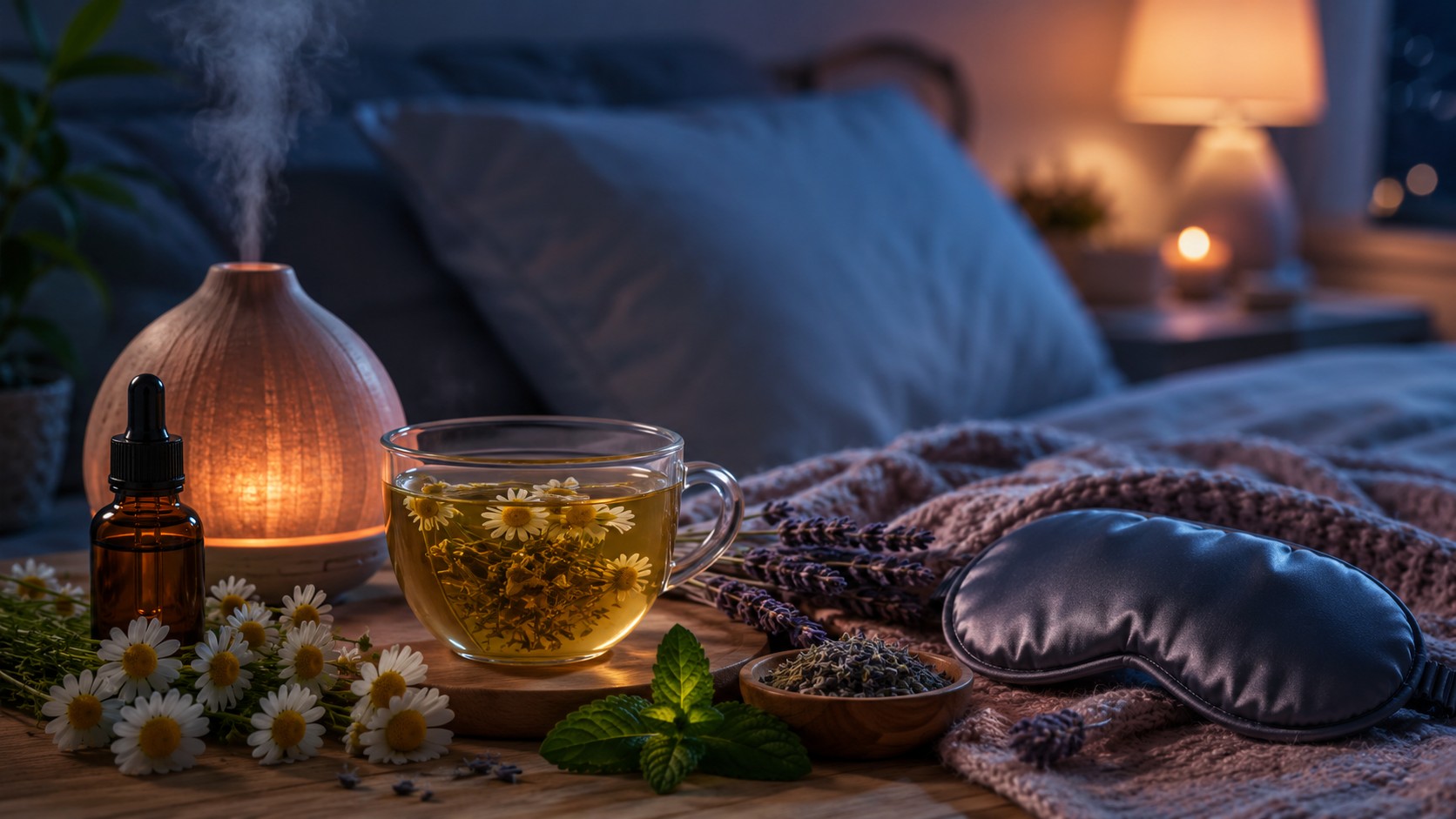
Chamomile tea remains the classic bedtime ritual for good reason. Beyond the placebo-like comfort of a warm drink, chamomile contains apigenin, a compound that binds to certain brain receptors associated with reduced anxiety and mild sedation. Because it’s gentle enough for nightly use, it works especially well as part of a wind-down ritual rather than as a stand-alone “fix.”
Passionflower
Although people talk about it less than valerian or chamomile, passionflower is still worth knowing about. In several small studies, it has shown modest improvements in sleep quality, particularly for people whose insomnia stems from anxiety. Additionally, it pairs well with breathing-based relaxation techniques.
Herbal remedies tend to work best as part of a consistent nightly ritual, rather than as an emergency “rescue” tool on your worst nights. Since your body responds to repetition and predictability, that’s part of why these remedies take a few nights to show their full effect.
Lavender (Aromatherapy) 🌸
Lavender’s reputation isn’t just clever marketing. In several small trials, inhaled lavender has shown mild anxiolytic, or anxiety-reducing, effects, which can help some people fall asleep slightly faster. Although it won’t cure insomnia on its own, it becomes a reasonable, low-risk addition when used as one layer in a broader essential oils and aromatherapy routine.
💊 Magnesium and Other Sleep-Supporting Supplements
People recommend magnesium constantly for sleep, and there’s a reasonable explanation why: magnesium helps regulate the nervous system, and a deficiency can contribute to muscle tension and restlessness at night. Therefore, for people who are genuinely low in magnesium — which is common with poor diet, high stress, or certain medications — supplementing can meaningfully improve sleep quality.
That said, magnesium isn’t a universal insomnia cure. If an irregular schedule or anxiety drives your sleep issue, magnesium alone won’t fix it; instead, it simply removes one possible obstacle.
| Supplement | Best For | Realistic Expectation |
|---|---|---|
| Magnesium glycinate | Muscle tension, restlessness | Gradual improvement over 1-2 weeks |
| L-theanine | Racing thoughts, mild anxiety | Calmer mind without sedation |
| Melatonin (low dose) | Circadian misalignment, jet lag | Shifts sleep timing, not a sedative |
If your insomnia has lasted more than three weeks, affects your daytime functioning, or pushes you to rely on supplements nightly just to feel “normal,” it’s worth talking to a doctor. Sometimes, persistent insomnia points to an underlying issue — such as hormonal imbalances or an undiagnosed sleep disorder — that natural remedies alone won’t resolve.
Ultimately, this connects to a pattern worth understanding: insomnia rarely shows up in isolation. Instead, it frequently tangles up with anxiety, and the two can feed each other in a loop that’s hard to break with herbs alone — which is exactly what we’ll unpack next. 👇
🛏️ Behavioral Remedies: The Most Underrated Fix
Most “natural remedies” articles skip this part entirely: the single most effective natural insomnia fix isn’t a supplement at all. Instead, it’s behavioral — specifically, it’s how you manage light, timing, and your relationship with your bed.
This matters because herbs and supplements work on your nervous system chemistry, yet they can’t override a body clock that’s been pushed out of sync by inconsistent sleep times, late-night screen exposure, or an irregular routine. For example, if you take valerian at 11 p.m. but your body doesn’t expect to feel sleepy until 2 a.m., the herb fights an uphill battle.
Fix Your Light Exposure ☀️
Light, not willpower, drives your body’s circadian clock. Even just stepping outside for 10 minutes of bright morning light helps anchor your body clock, so melatonin release happens on schedule that night. Meanwhile, dim, warm light in the evening — combined with minimizing screens and blue light exposure for the hour before bed — signals to your brain that nighttime is approaching.
Myth: “Blackout curtains and total darkness are the only way to sleep well.” Fact: although darkness helps sleep onset, consistent light exposure timing — bright in the morning, dim at night — matters most for insomnia specifically, not achieving total darkness every single night.
Build a Wind-Down Sequence, Not Just a “Bedtime” 🌅
One of the most common mistakes involves treating sleep like a light switch — working or scrolling at full mental intensity until the exact moment you decide to “go to sleep.” In reality, your nervous system needs a transition period. Because of this, a consistent 30–45 minute wind-down sequence — dim lights, no screens, a repeated set of calming activities — trains your body to recognize the cues that sleep is coming.
This is exactly where simple breathing routines earn their reputation. Specifically, slow, controlled breathing — like extending your exhale longer than your inhale — activates your parasympathetic nervous system, which acts as the physiological “off switch” for the hyperarousal we discussed in Part 1.
Keep Your Bed Associated With Sleep Only 🚫📱
If you regularly work, scroll, or worry in bed, your brain starts associating the bed itself with wakefulness and stress instead of sleep. Experts call this well-documented insomnia driver “conditioned arousal.” Although the fix sounds simple in concept — use your bed only for sleep and intimacy — it takes consistency to actually retrain the association.
| Common Mistake | Better Approach |
|---|---|
| Lying in bed scrolling when you can’t sleep | Get up, do something calm and dim-lit, return when sleepy |
| Inconsistent wake times on weekends | Keep wake time within ~1 hour of your weekday schedule |
| Napping for 1-2+ hours in the afternoon | Keep naps under 30 minutes, earlier in the day |
| “Trying harder” to fall asleep | Focus on relaxation, not forcing sleep — pressure backfires |
Try Progressive Muscle Relaxation 💪
This underrated, completely free technique involves systematically tensing and then releasing each muscle group, starting from your feet and working up to your face. In effect, it directly signals to your nervous system that it’s safe to power down. It also pairs especially well with a short guided meditation routine if your mind tends to wander.
If a racing mind drives your insomnia more than physical tension does, it’s worth reading more about how anxiety and insomnia feed into each other. In that case, addressing the anxiety loop directly — rather than just the sleep symptom — becomes the most effective “remedy.”
🚩 What Doesn’t Work (Despite What Influencers Say)
Being honest about natural remedies also means being honest about what’s overhyped. Below are a few areas where well-meaning advice often falls short:
| Popular Claim | Reality Check |
|---|---|
| “Just take melatonin every night” | Melatonin shifts timing, it doesn’t sedate. Nightly long-term use without addressing the root cause can mask the real problem. |
| “CBD cures insomnia” | Evidence is still limited and mixed; effects vary hugely between people and products. Not a reliable stand-alone fix. |
| “A nightcap helps you sleep” | Alcohol can make you drowsy initially but fragments sleep later in the night, often worsening sleep quality overall. |
| “You just need willpower to fall asleep” | Trying harder to sleep increases mental arousal — the opposite of what your nervous system needs. |
If you’ve tried several remedies for 2-3 weeks with zero improvement, treat that as useful information rather than personal failure. Usually, it means a behavioral or psychological factor drives the root cause more than a chemical one does, which is worth addressing directly instead of rotating through more supplements.
Next, let’s pull all of this together into something you can actually use tonight, plus the FAQs people ask most often when trying to fix insomnia naturally. 🌟
🗓️ Putting It All Together: A Realistic First Week
You don’t need to overhaul your entire life tonight. Generally, trying to add five new herbs, a new bedtime, a new wind-down routine, and a meditation practice all at once backfires, because overwhelm itself disrupts sleep. Instead, here’s a realistic way to layer these natural remedies for insomnia over one week:
| Days | Focus | What to Do |
|---|---|---|
| Days 1–2 | Light & timing | Get morning light, dim lights 1 hour before bed, pick a consistent wake time |
| Days 3–4 | Wind-down ritual | Add a repeatable 20-30 minute routine — tea, breathing, or light reading |
| Days 5–7 | Targeted support | Introduce one herbal remedy or supplement (not three at once) and track how you feel |
This layered approach also makes it much easier to know what’s actually working. For instance, if you change everything at once and your sleep improves, you won’t know whether the chamomile, the light exposure, or the earlier bedtime caused it. Therefore, one change at a time gives you real, useful feedback about your own body. 📊
Natural remedies for insomnia work best when you match them to the actual cause — hyperarousal, circadian misalignment, or anxiety — and layer them gradually rather than all at once. Herbs and supplements help, but consistent light exposure, a wind-down routine, and protecting your bed as a “sleep-only” space tend to produce the most lasting results.
❓ Frequently Asked Questions
What is the most effective natural remedy for insomnia?
Honestly, there isn’t one universal answer — it depends on your specific cause. For anxiety-driven insomnia, breathing techniques and L-theanine tend to help most. When a disrupted body clock is the culprit, light exposure timing matters more than any herb does. And for general restlessness, magnesium paired with a consistent wind-down routine usually works best as a starting point.
How long do natural remedies for insomnia take to work?
Typically, behavioral changes like light exposure and a consistent sleep schedule show improvement within 1-2 weeks. Herbal remedies like valerian or chamomile, on the other hand, may take several consecutive nights of use before you notice effects, since they work gradually rather than as an instant sedative.
Can I combine multiple natural remedies for insomnia at once?
You can, but it’s smarter to introduce one new remedy at a time. Otherwise, combining several at once makes it hard to know what’s actually helping, and some combinations — like multiple sedating herbs — can cause unwanted grogginess.
Is melatonin a natural remedy for insomnia?
Your body produces melatonin naturally, and supplemental melatonin can help — but it works by shifting your sleep timing, not by sedating you. As a result, it’s most useful for circadian issues like jet lag or a shifted sleep schedule, rather than as a nightly cure-all.
Why do natural remedies for insomnia work for some people but not others?
Since insomnia has multiple possible root causes, a remedy that targets hyperarousal won’t do much if a misaligned body clock causes your real issue (or vice versa). Additionally, individual body chemistry and sensitivity to herbs vary significantly from person to person.
Are natural remedies for insomnia safe to use every night?
Most of the remedies discussed here — chamomile, magnesium, light management, breathing exercises — are considered safe for regular use. Valerian and melatonin are generally fine short-term, although it’s worth discussing nightly long-term use with a doctor, especially if you take other medications.
Can anxiety make natural remedies less effective?
Yes — if unresolved anxiety primarily drives your insomnia, herbal remedies can take the edge off but won’t fully resolve the issue alone. In that case, addressing the anxiety directly, through techniques like cognitive reframing or professional support, often needs to happen alongside any natural remedy.
What should I avoid if I have insomnia?
Generally, you should avoid using your bed for work or scrolling, inconsistent wake times, alcohol as a sleep aid, caffeine in the afternoon or evening, and “trying harder” to force sleep — since all of these tend to worsen insomnia rather than fix it.
When should I see a doctor about insomnia instead of trying natural remedies?
If insomnia has persisted for more than three weeks, significantly affects your daytime functioning, or natural remedies and behavioral changes haven’t helped despite a genuine, consistent effort, it’s time to talk to a doctor. That way, you can rule out an underlying sleep disorder or medical cause.
Do natural remedies for insomnia actually have scientific backing?
Some do — valerian, chamomile, magnesium, light-exposure timing, and breathing techniques all have research support, even though the effect sizes vary. Others, like many trending “TikTok sleep hacks,” have little to no real evidence behind them, so it’s worth being selective rather than trying everything you see online.
✅ Key Takeaways
- 🌙 Insomnia usually stems from one (or a mix) of three causes: hyperarousal, circadian misalignment, or anxiety/stress.
- 🌿 Herbal remedies like valerian, chamomile, and passionflower have genuine — though modest — research support.
- 💊 Magnesium and L-theanine can help, but only if your insomnia is actually linked to what they target.
- ⏰ Melatonin shifts sleep timing; it isn’t a sedative and isn’t meant for nightly long-term use without addressing the root cause.
- ☀️ Light exposure — bright in the morning, dim at night — has a bigger impact on your body clock than most people realize.
- 🧘 A consistent 30-45 minute wind-down routine helps your nervous system transition into sleep mode.
- 🫁 Breathing techniques and progressive muscle relaxation directly calm an overactive nervous system.
- 🛏️ Using your bed only for sleep helps break the mental association between your bed and wakefulness/stress.
- 🔄 Introduce one new remedy at a time so you can actually tell what’s working.
- 🚩 Alcohol, CBD-as-a-cure-all, and “just try harder” are commonly overhyped and not reliable fixes.
- 📋 Natural remedies work best as a layered routine, not a single emergency fix.
- ⚠️ Persistent insomnia (3+ weeks) or daytime impairment is a signal to see a doctor, not just try more supplements.
🌟 Conclusion
Natural remedies for insomnia aren’t a myth, but they’re not magic either. The ones genuinely worth your time — valerian, chamomile, magnesium, light management, breathing techniques, and a real wind-down routine — work because they target one of the actual root causes of insomnia: an overactive nervous system, a misaligned body clock, or unresolved stress.
Realistically, the best path forward isn’t trying everything at once. Instead, it’s identifying what’s actually driving your sleeplessness, picking one or two remedies that match that cause, and giving them a genuine week or two before judging whether they’re working. If you’ve done that consistently and nothing’s shifted, treat that as valuable information — and a good reason to loop in a doctor rather than keep guessing.
Sleep doesn’t usually improve overnight. However, with the right remedy matched to the right cause, most people do start noticing a real difference within a couple of weeks. 🌙✨

0 Comments